Three images from the spring of 2026 frame the future of air and missile defense better than any doctrine paper. In the first, a single Iranian one-way attack drone slipped past American defenses at Port Shuaiba in Kuwait on March 1. It was slow, low, and cheap, and it killed six U.S. servicemembers. They were the first American deaths U.S. Central Command would confirm. In the second, an Iranian strike in the war’s opening days destroyed an AN/TPY-2 radar at Muwaffaq Salti Air Base in Jordan. CNN’s satellite analysis and later U.S. officials confirmed the loss. That radar is the X-band sensor at the heart of a Terminal High Altitude Area Defense battery, and the United States fields only eight of those batteries worldwide. In the third, and most consequential, U.S. intelligence assessed that roughly half of Iran’s missile launchers remained intact after more than five weeks of bombardment. Most were buried in tunnels and dispersed. In one official’s words, they were still poised to wreak absolute havoc.
These events span the cost spectrum, from a $20,000 drone to a radar worth several hundred million. Yet in none of them did the interceptor fail. In the first case, the chain meant to detect, identify, and cue a shooter never closed in time. In the second, the adversary skipped the interceptor and shot out the system’s eyes. In the third, the offensive chain meant to find and finish Iran’s launchers before they fired could not close at all. Read against three years of Russia’s air war on Ukraine, the same conclusion emerges. The decisive contest in air defense has moved off the interceptor. It now runs through the sensors, the networks, and the seams between detecting a threat and killing it. There is a testable version of this claim. In the next major salvo against a U.S. or allied base, the most damaging loss will not be an emptied magazine. It will be a downed sensor, a severed command node, or a launcher never found.
The Chain, Not the Missile
“Sensor-to-shooter” is the unglamorous plumbing of air defense. It runs in five steps. Detect, track, identify, decide, engage. Procurement theater fixates on the last link, the interceptor itself. But an interceptor is only as good as the warning, the clean track, and the confident identification that come before it. The defensive chain also has an offensive twin. That twin is the find-fix-finish loop that hunts launchers before they shoot. It is the cheapest interception of all, because it kills the threat on the ground. Both wars show the binding constraints sit in these upstream links. A competent adversary attacks the chain rather than trying to beat the missile.
Iran’s Broken Chain
Iran spent two decades building air defenses, importing Russian S-300s and fielding indigenous Bavar-373 and Khordad-15 batteries. In two consecutive wars they accomplished almost nothing. The Foreign Policy Research Institute’s postmortem on the June 2025 war found the reason. Drawing on Center for Nonproliferation Studies imagery of the command center near Natanz, it concluded the system was not meaningfully networked. A seam ran between Iran’s early-warning radars and its surface-to-air batteries. Data was handed from box to box in a way that bred delay and uncertainty. Israel held air superiority within days. A massive opening wave in February 2026 gutted Iran’s defenses and decapitated the regime before it could coordinate a response.
Iran did not lose for want of shooters. It lost because the chain never closed. Then it applied the same logic in reverse. Unable to out-shoot Western interceptors, it attacked the sensors and flooded the decision layer. The Muwaffaq Salti strike was the purest expression. As N.R. Jenzen-Jones of Armament Research Services observed, the AN/TPY-2 is the heart of a THAAD battery, and losing even one is operationally significant. Knocking out a single irreplaceable node degraded high-altitude surveillance across the Levant and the Gulf. It also shifted more burden onto Patriot batteries whose interceptors were already scarce.
Not All Seams Are Equal
Here is the part most cost-exchange commentary misses, and it forces a hierarchy onto the argument. In June 2025, Israel’s defenses succeeded largely because its offense and its passive defenses did the heavy lifting. FPRI is explicit on this. Israel held air superiority, sealed the mouths of Iran’s underground missile cities, and struck transporter-erector launchers on the move. That shrank Iranian salvos until they were small enough for active defenses to handle. Hardened shelters and dispersal kept airbases in the fight. The active sensor-to-shooter chain did not win on its own. The offensive find-fix-finish chain and passive measures were its preconditions.
That ranking matters, because not all seams cost the same to leave open. The most expensive is the launcher you never find. It feeds every downstream link with more shots than any magazine can absorb. In 2026 that is exactly the seam that stayed open. After five weeks, U.S. intelligence assessed that roughly half of Iran’s launchers were still intact. Most were buried or inaccessible rather than destroyed. The measurement itself fractured. Israel claimed to have destroyed about 60 percent of Iran’s roughly 470 launchers. It counted only 20 to 25 percent as truly out of action. A Reuters-cited assessment put confirmed destruction near a third. That gap is not pedantry but a targeting failure in its rawest form. You cannot fix and finish what you cannot reliably find, and decades of Iranian tunneling defeated the locating half of the chain. An offense that could not close was one reason the Gulf spent weeks absorbing saturation rather than a short, decisive barrage. Iranian pacing, ceasefire dynamics, and Tehran’s interest in prolonging its leverage over the Strait of Hormuz also played a part. When the offensive chain cannot finish, the difference lands on the defensive magazine.
How Ukraine Built a Chain to Survive
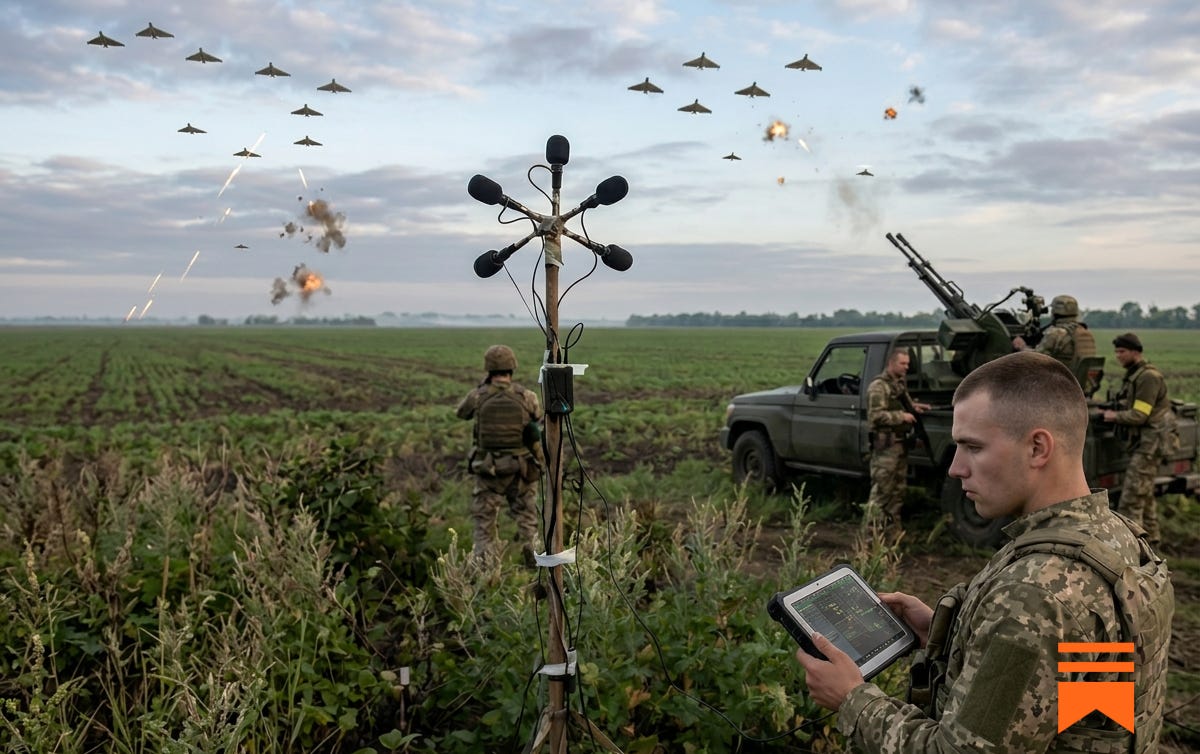
If Iran shows a brittle, centralized chain, Ukraine shows the inverse. Kyiv assembled its chain from the bottom up out of consumer hardware. The detection layer is the Sky Fortress network. It runs on more than ten thousand acoustic sensors, by some estimates tens of thousands. Each costs a few hundred to a thousand dollars. They listen for the engine signature of low-flying drones that radar misses. The data is triangulated, fused with radar into a common picture, and pushed to shooters on tablets.
The shooters are deliberately attritable and layered. Electronic warfare is the quiet workhorse. President Volodymyr Zelensky routinely credits jamming alongside mobile fire groups for downing most incoming drones. But that layer is in an arms race it is partly losing. The Institute for Science and International Security documents the counter. Russia now fields Shaheds with controlled-reception-pattern antennas and software-defined radios. It has added jet and fiber-optic variants built to defeat Ukrainian jamming. That erosion is what pushed Kyiv toward cheap kinetic interceptors. Its commander-in-chief stated in February 2026 that interceptor drones were downing more than 70 percent of Shaheds over the Kyiv region. Ukraine also runs its own offensive half of the chain. It strikes Russian launch sites and Shahed production deep behind the lines, hitting the threat before it flies.
The architecture is the photographic negative of Iran’s. It is distributed, so no node’s loss collapses it. It is redundant, so degradation is graceful. And it is cheap enough that attrition arithmetic favors the defender. Yet it is under constant pressure. CSIS tracked Russia scaling Shahed launches from roughly 200 a week to more than 1,000. Moscow mixes decoys with live warheads to overwhelm the identification and engagement links, not any single sensor. That is the same insight Iran exercised in the Gulf. Air defense is not a wall but a contest of adaptation. Ukraine’s real edge is less any gadget than a culture of weekly revision against an adversary’s multiyear procurement cycle.
These are not two stories but one. It is the same airframe, the Shahed that Russia mass-produces as the Geran, and the same saturation doctrine. The playbook is now migrating between theaters. Within days of the Iran war’s opening, Zelensky offered the Gulf states an exchange of Patriot and interceptor-drone know-how. Kyiv has since dispatched counter-drone specialists and mobile-fire-group instructors to the region. For the drone tier, the cheap and distributed model is becoming the center of gravity. But only that tier. The ballistic missiles that produced most of the Gulf’s casualty-generating salvos remain the problem of the exquisite upper layer. No acoustic mesh or gun-truck can replace it.
What the Two Wars Agree On
First, the weak link is the sensor, the network, and the seam, not the shooter. Iran failed at the handoff, the Gulf lost a sensor, and the offense could not find buried launchers.
Second, magazine depth and cost-exchange are strategic. FPRI found that defending against roughly 500 Iranian missiles in June 2025 nearly exhausted Israel’s anti-ballistic stocks. It also consumed about a quarter of U.S. THAAD and SM-3 inventories, plus years of production, in under two weeks. In 2026 the strain turned chronic. The UAE alone reported engaging hundreds of ballistic missiles and more than two thousand drones over roughly five weeks. A PAC-3 MSE costs around $4 million. A Shahed costs a few tens of thousands. The cost-exchange ratio runs from roughly 80-to-1 into the hundreds. Representative Ted Lieu called it “throwing Ferraris at Frisbees,” in remarks reported by The Washington Times.
Third, concentration kills. The exquisite, centralized node is a single point of failure precisely because there is one of it. Distribution is survival.
Red Team, Where the Argument Bends
An honest analyst tries hardest to break his own thesis. Here are five fracture points.
The first is the temptation to over-learn from Ukraine. An acoustic mesh and gun-trucks are superb against loud, low, slow Shaheds. They are useless against a ballistic missile arriving in minutes. The transfer of Ukrainian methods is real but bounded to the drone tier.
The second is that the TPY-2 loss may be overstated. The Foundation for Defense of Democracies’ Ryan Brobst noted that other radars and space-based cueing mitigate any single sensor’s loss. The framing about blinding the United States is partly an information operation.
The third is that cost-exchange is a seductive but partial metric. By the Israeli Defense Ministry’s own assessment, reported by FDD, June 2025 interceptions prevented more than $15 billion in property damage. You cannot put a $2,000 interceptor against a reentry vehicle aimed at a city. The number that matters is not dollars-per-dollar. It is whether the one catastrophic leaker gets through.
The fourth is that nearly all interception statistics are belligerent-reported. UAE and Israeli tallies, CENTCOM’s claimed reductions, and even the launcher-destruction figures are unverified. As the 60-versus-25-percent split shows, two allies cannot agree on what destroyed even means. Every percentage here is a claim, not a finding.
The fifth is that distributed networks have their own brittleness. Acoustic nodes lose range in bad weather and miss quiet electric quadcopters. They also lean on cellular backhaul that electronic warfare or cyber can sever. Pushing the trigger to many dispersed shooters multiplies fratricide risk. War on the Rocks reported a friendly-fire downing of U.S. aircraft by Kuwaiti defenses amid the saturation, though that account remains unverified.
The honest conclusion is the one the Modern War Institute reaches. The answer is both tiers, not either. The cheap layers depend on the exquisite layer’s sensors. The high-end interceptors remain a sovereign capability adversaries cannot buy. The point is not to abandon the expensive tier, but to see that its center of gravity has moved to the network that cues it and the offensive chain that lightens its load.
Where This Is Going
Air defense is bifurcating into a sovereign high tier of Arrow, THAAD, Patriot, and the SM family, and an attritable low tier of interceptor drones, guns, and electronic warfare. Automation is fusing them at machine speed. The U.S. Army’s Golden Shield experiment demonstrated an autonomous sensor on one platform cueing a weapon on another to kill a drone. That speed also multiplies the fratricide and spoofing risks the red team flagged. The magazine problem is driving directed energy. Israel fielded its operational Iron Beam laser in December 2025. The laser thins the drone tier at short range, but it cannot reach medium-range ballistic threats. The unglamorous answer, industrial throughput, is now treated as strategy. Lockheed Martin is tripling PAC-3 output toward 2,000 a year.
The most direct answer to the lesson of Muwaffaq Salti is moving to orbit. The Space Development Agency’s Proliferated Warfighter Space Architecture is the sensing backbone of the planned Golden Dome. It aims to replace a handful of precious forward radars with a low-Earth-orbit mesh of missile-tracking satellites. Those satellites are built to keep custody of targets that no single strike can blind, including maneuvering hypersonic glide vehicles. But the system is years out. The latest tranche is not slated to launch until around 2029. And the constellation is itself a target set in any great-power war, not a sanctuary.
These stakes are not confined to the Middle East. FPRI’s warning is blunt. If a quarter of U.S. THAAD and SM-3 stocks went in two weeks against Iran’s ragged salvos, a Pacific fight would be far worse. The People’s Liberation Army Rocket Force can range Guam with hundreds of intermediate-range missiles. The Israeli strategy of counterforce and sealed missile cities cannot be replicated against the Chinese mainland. The kill-chain, magazine, and counterforce lessons matter most precisely where they are hardest to apply.
The hardest layer is organizational. The Iran war was fought over the airspace of Jordan, Iraq, Kuwait, Bahrain, Qatar, Saudi Arabia, the UAE, and, at the edges, Turkey, with U.S., Israeli, and Gulf systems engaging the same raids. A coalition kill chain stitched from national sensors that do not share a real-time air picture will reproduce, at the alliance level, the very seam that doomed Iran’s domestic system. The recommendation that follows is simple. Invest in the network, in sensor resilience, and in the offensive find-fix-finish chain at least as heavily as in interceptor magazines. A fuller magazine cannot compensate for a sensor that has been shot out or a launcher that was never found. The trade-off is real and politically expensive. Genuine federation means sharing sensitive sensor data and ceding some national control over engagement authority. The shared network it creates becomes its own attack surface for cyber and electronic warfare. There is no architecture that removes the seam. There is only the choice of where to put it and how hard to defend it.
Conclusion
The next air war will be decided across the whole chain. It turns on the seam between the sensor and the shooter. It turns on the hunt for the launcher before it fires. And it turns on whether the network keeps closing while it is jammed, saturated, and struck. Iran built a chain that could not close. It then taught the world to shoot the sensor and bury the launcher. Ukraine built a chain cheap and redundant enough to keep working while hit. Buy the exquisite interceptors. They are irreplaceable. But stop treating the missile as the hard part. The hard part is the chain.
Sertaç Canalp Korkmaz was a specialist at the Presidency of the Republic of Türkiye from 2019 to 2024. He holds a PhD and an MA in security studies from the Turkish National Police Academy, along with a BA in International Relations from Selçuk University. He served as an assistant researcher at the Center for Middle Eastern Studies (ORSAM) from 2016 to 2019. He was also a visiting lecturer at the Turkish Military Academy from 2021 to 2024. Dr Korkmaz conducted field research in various cities in Türkiye and northern Syria. He was nominated to participate in the U.S. Department of State’s prestigious International Visitor Leadership Program for Spring 2024.