In 2000, as commander of Air Combat Command, Gen. John Jumper challenged the U.S. Air Force to kill fleeting targets in single-digit minutes. Two years later, as chief of staff, he attached a figure to it, the kill chain. The span between a sensor finding a target and a shooter striking it could be squeezed under ten minutes. With Predators newly armed and the memory of futile Scud hunts still raw, it sounded audacious.
A quarter-century later, it sounds quaint. The find-fix-track-target-engage-assess sequence now runs in seconds under favorable conditions. The two wars that have most shaped strategic thinking in the mid-2020s, Russia’s war in Ukraine and the campaign against Iran, are usually read as a duel between two ways of building, cheap and distributed versus exquisite and integrated. The binary is tidy and incomplete. These wars show three distinct solutions, and the third does not sit on the same axis as the others. But the most uncomfortable lesson is not which solution to choose.
The United States chose two years ago, wrote the answer into policy, spent against it, and could not field it. The decisive variable in the next war is not vision. It is whether a force built to deliver the large, exquisite, and few can learn to deliver the small, cheap, and many before it needs to.
The Compression That Worked
Compressing the kill chain was always a war on bureaucracy and physics. The Cold War cycle collects, analyses, reports, and tasks, assuming scarce intelligence and static ground. Against a launcher that shoots and scoots in minutes, that linear process is a guarantee of failure, as the coalition learned in 1991 chasing Iraqi mobile Scuds that fired and vanished. The fix was to flatten the chain into a network where any sensor could cue any shooter, machine-to-machine, the logic behind Joint All-Domain Command and Control.
The unglamorous part is that the obstacle was never the kinetics. When the Army linked Air Force sensors to Army fires in 2019, the breakthrough was not a weapon but translation software, because the two services’ networks could not otherwise exchange a targeting message. The hard part is the seams. As Heather Penney argued, scale, scope, speed, and survivability. It is the last, not speed, that now decides wars.
Model One: The Improvised Web
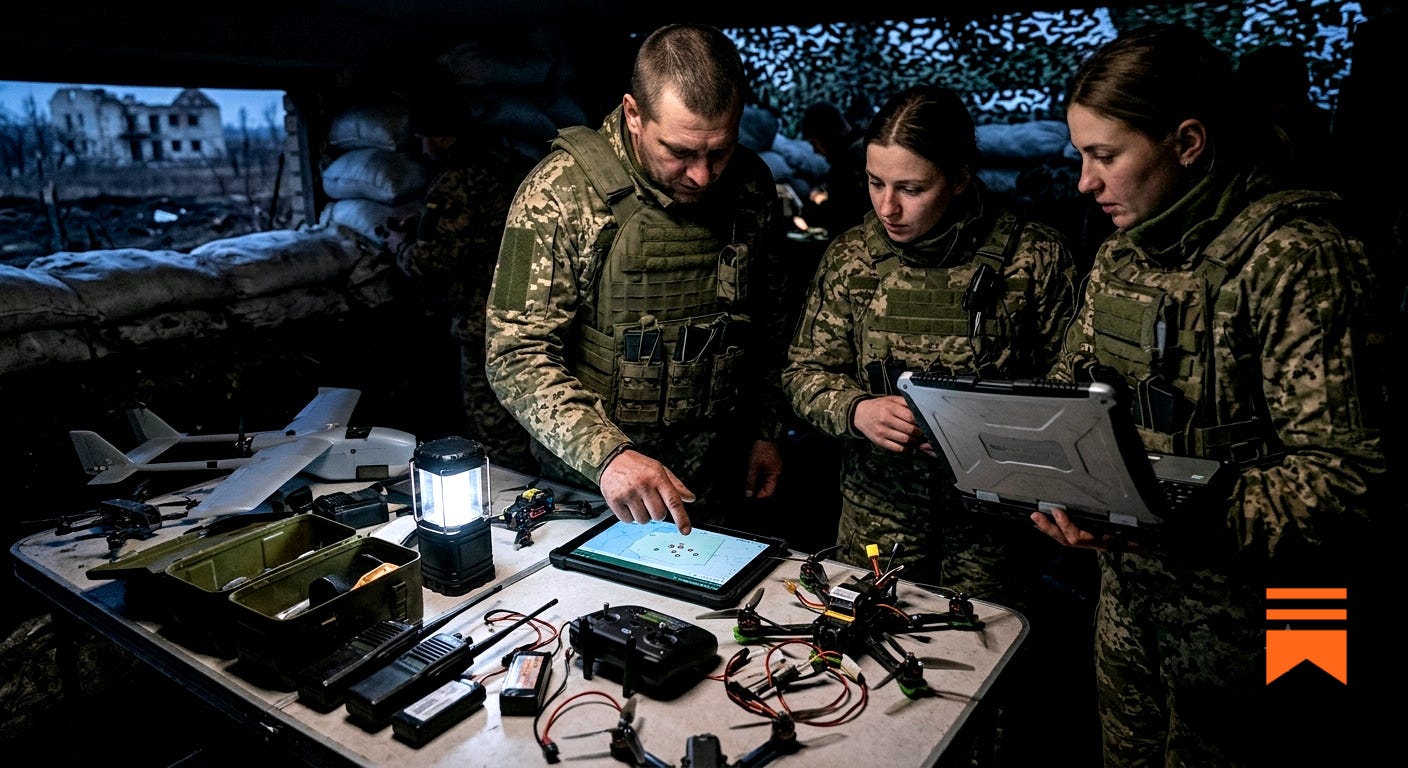
Ukraine built its chain from the bottom up. Its emblem is Kropyva nettle, a homegrown Ukrainian fire-control app that runs on an ordinary tablet, computes a firing solution from a target marked on a digital map, and lets dispersed guns mass on it, complicating the enemy’s counter-battery problem in the process. Pair it with cheap drones that mark targets and pass coordinates and imagery to artillery in near real time, and you have the distributed sensor-to-shooter web that Western concept papers theorized for a decade.
This is the timing duel that field-artillery doctrine has always understood. U.S. ATP 3-09.12 treats reactive counterfire as a race. The sensor-to-shooter loop against the enemy’s time to displace. Kropyva wins that race cheaply, and that is its strategic point resilience and reconstitution at the price of a consumer device.
But a web of civilian parts inherits civilian weaknesses. In 2022, Elon Musk ordered Starlink coverage cut over part of Kherson during a counteroffensive, and drones and artillery coordination went dark, a war-shaping decision made by one private firm. The radio links are jammable, and the software is itself a target. A group tied to Russian military intelligence reportedly compromised an Android app that Ukrainian gunners relied on. What can be assembled from commercial parts can be degraded by anyone who can reach them.
Model Two: The Integrated Network, and What It Truly Does Well
The June 2025 war on Iran is usually filed under the second model, the top-down, all-domain network. Look closely, and the category wobbles. Where the architecture genuinely excelled was not speed but planned mass against fixed targets. Operation Midnight Hammer sent seven B-2s to drop fourteen bunker-busters on Fordow and Natanz, the weapon’s first operational use, while a submarine struck Isfahan behind a decoy package. This was the antithesis of the single-digit-minute ideal. A deliberate strike long in the planning, rehearsed against a mountain that could not move.
That is the network’s real comfort zone, and it is narrower than the JADC2 vision advertises. The deliberate strike on a target that holds still. Even there the limits showed initial assessments called the enrichment capacity obliterated, yet the Air Force’s own doctrinal account frames the operation as one meant to compel a change in Iran’s nuclear course, not merely to flatten a facility. The network can destroy a building on schedule. It cannot guarantee the outcome that the building stood for.
Model Three: Erasing the Distance
The genuinely hard sensor-to-shooter problem against Iran was its relocatable ballistic-missile force, the Scud hunt of 1991, at scale. Israel did not solve it with a faster chain. It refused the premise.
The first two models answer the same question. How do we close the chain faster? One cheaply, one richly. The third does not. In Operation Rising Lion, Israel struck Iranian launchers and command nodes not through any-sensor-any-shooter pairing but by pre-positioning drones and precision weapons inside Iran and triggering them at H-hour, the payoff of years of human penetration and persistent surveillance that put sensor and shooter inside the target country before the war began. The chain was not closed across distance, the distance was erased.
This is intelligence-led and embedded, not networked and remote, and it is the least exportable of the three. The United States knows the method from two decades of intelligence-driven targeting, but Israel’s depth of penetration into a single adversary is not a capability summoned on demand, least of all against a hardened, counterintelligence-prepared peer that has now watched the playbook run. To cite Rising Lion as proof of the networked model is to mistake a feat of espionage for a feat of architecture.
Why the Magazine Decides
The obvious objection is that the high-end models won and won overwhelmingly. Iran’s sites were obliterated or badly damaged, its launchers hunted, and no Israeli aircraft were lost. Why not double down?
Because winning every engagement is not winning the war, and the Iran campaign showed the seam. The fixed-target triumph was deliberate, not a repeatable chain. The launcher triumph was intelligence-led and unrepeatable on demand. And both victors hit the wall, no architectural engineers around, the magazine. Iran fired more than 500 ballistic missiles in twelve days, and holding the line meant a serious drawdown of U.S. and Israeli interceptors. When the war resumed in 2026, the binding question was never whether the high end could strike, but whether it could keep striking and keep defending after the first salvo. If both sides can strike in seconds, speed cancels out, and the decisive variable is resilience under degradation, the ability to keep the web running and the bins full while the enemy tears at both. That is the lesson all three field models share.
The Bet America Made and Could Not Pay Out
Here is where most analyses end, prescribing more attritable mass. But that is not a contrarian recommendation, it is a two-year-old policy. In August 2023, Deputy Secretary of Defense Kathleen Hicks launched the Replicator initiative to field thousands of attritable autonomous systems against Chinese mass weapons she called small, smart, cheap and many, while granting that the United States still leans on a handful of large, costly, exquisite platforms. The vision matched the Ukraine lesson almost exactly. America did not misread the war. It read it correctly and then could not act on what it read.
By the August 2025 target, the Pentagon had fielded hundreds rather than thousands of the promised systems, slowed by technical failures, integration gaps, and platforms chosen before they were finished. The effort was eventually folded and rebranded toward larger, more conventional systems. The shortfall was not a Replicator quirk, it was the system showing its baseline. By the Government Accountability Office’s own accounting, the average major defense program now takes about eleven years to deliver an initial capability, up from eight, and weapons acquisition has long sat on GAO’s High Risk List. A defense-acquisition expert told the House Armed Services Committee that the Pentagon’s process simply cannot operate on Replicator’s timelines except outside the normal budgeting rules. Replicator, in that light, was less a program than an attempt to route around the government’s own acquisition machinery an effort that, even on its own terms, some judged misdirected from the start.
The contrast along Ukraine’s front line is the indictment. Ukrainian drone output climbed from roughly 800,000 in 2023 to as many as 5 million by 2025, a scale that dwarfs American precision-weapons procurement, counted in the hundreds or, in a banner year, the thousands. Ukrainian teams iterate on direct combat feedback within weeks, and units even modify delivered drones before flying them at a tempo that would stall most Western procurement programs outright. The United States, by Bloomberg’s reporting, builds on the order of 100,000 combat drones a year.
That gap is the point, and it is more sobering than a wrong procurement choice. The qualities that make Ukraine’s web work improvisation, tolerance for loss, weeks-long iteration, the fusion of commercial parts under wartime pressure are precisely the ones a peacetime great-power bureaucracy, built in its tempo, testing culture, and risk aversion to deliver the large, exquisite, and few, is structurally worst at producing. The magazine tells the same story by another name. CSIS war games found that a Taiwan war could drain key long-range precision-munition stocks in roughly a week. Members of Congress have urged cheap, fast complements, repurposed Harpoons, and powered bombs to backstop scarce missiles. The ideas are not the bottleneck. The institution is.
The kill chain has three faces, and the United States has studied all of them. It even placed the right bet. The wars of the 2020s suggest the winner will be whoever can actually field the deep, redundant, self-healing web everyone now knows they need and keep the bins full. We spent twenty-five years learning to close the loop in single-digit minutes. The harder problem turns out not to be knowing what comes next. It is becoming the kind of force that can build it.
Sertaç Canalp Korkmaz was a specialist at the Presidency of the Republic of Türkiye from 2019 to 2024. He holds a PhD and an MA in security studies from the Turkish National Police Academy, along with a BA in International Relations from Selçuk University. He served as an assistant researcher at the Center for Middle Eastern Studies (ORSAM) from 2016 to 2019. He was also a visiting lecturer at the Turkish Military Academy from 2021 to 2024. Dr Korkmaz conducted field research in various cities in Türkiye and northern Syria. He was nominated to participate in the U.S. Department of State’s prestigious International Visitor Leadership Program for Spring 2024.