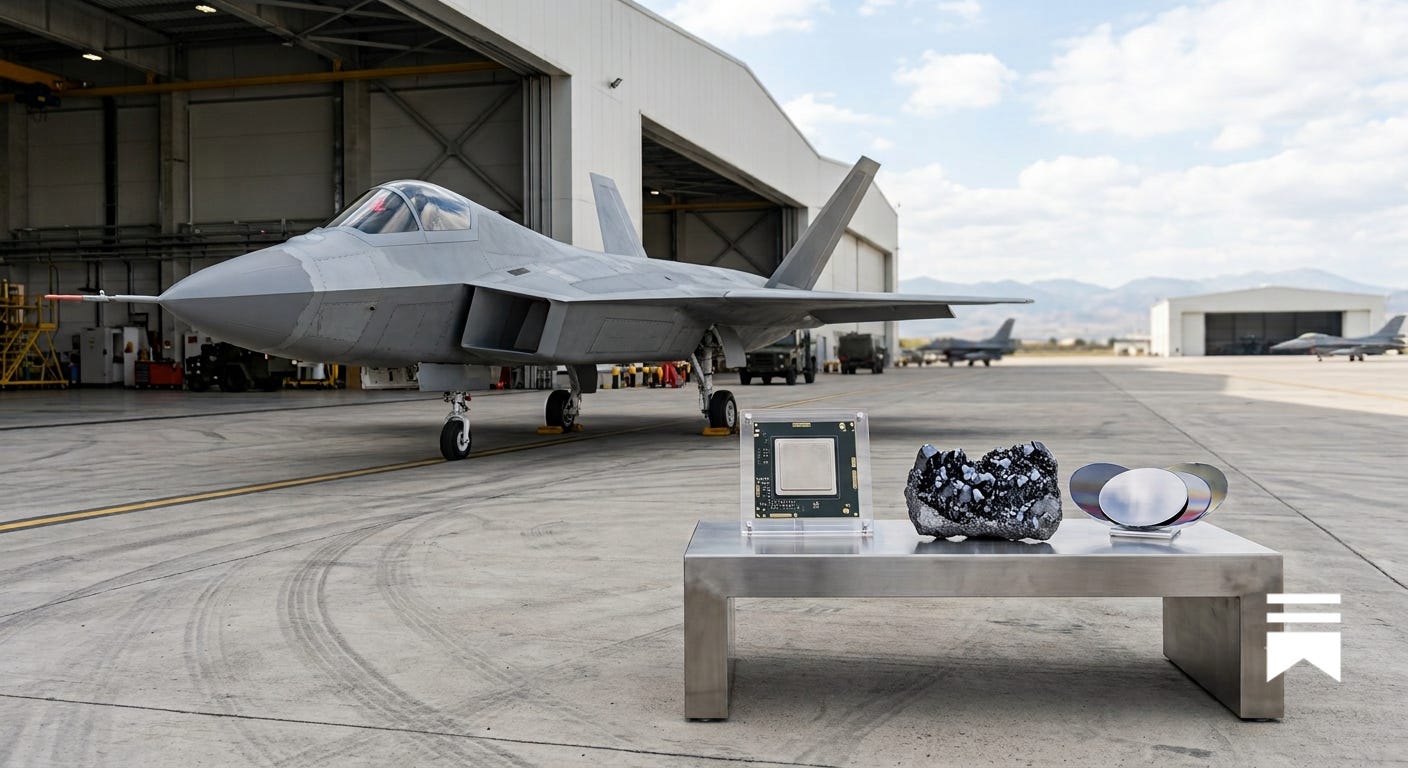
Turkey learned the cost of dependence in 1974. After its intervention in Cyprus, the United States and several European states restricted arms transfers to Ankara. An arsenal that belongs to someone else can be switched off. The institutions that define Turkish defense today grew out of that lesson. ASELSAN was founded in 1975 to reduce reliance on foreign electronics, and a generation later, the S-400 dispute and the CAATSA sanctions that followed renewed that conviction. Turkish defense autonomy is an anti-embargo project, and by its own standards, it has largely succeeded. The difficulty is that denial has more than one form. A platform license can be withheld in public, and Turkey has learned to route around that. A material can be quietly withheld far up the supply chain, and that is the exposure the country has spent two decades failing to measure.
Begin with what is true, because the localization story is mostly a success. Over two decades, Turkey has built one of the most capable mid-tier defense industries in the world. Baykar turned the armed drone into an export category and a diplomatic instrument. ASELSAN fields radar, electronic warfare, and communications systems that many larger states cannot, under a deliberate localization program. HAVELSAN and domestic command software give Turkish systems an indigenous brain that no foreign vendor controls. In platforms, systems, and software, Turkish independence is a real capability that has survived real sanctions. Any honest analysis starts here.
The Metric Measured the Wrong Layer
The trouble is what the success metric counts. Domestic content ratios measure the platform, not the input. A drone can be ninety percent local by value and still depend on one foreign material three steps up the chain, and the ratio also hides what is already foreign. By the procurement agency’s own count, about thirty-five percent of Turkish defense exports still carry American subsystems. The most credible warning comes from inside the sector, where a senior ASELSAN adviser acknowledged that the industry still struggles with special alloys, certain chemicals, advanced chips, and sensors. None of those is a platform. They are the materials beneath the platforms, and dependence did not vanish when Turkey localized its systems. It moved down the stack, to a layer that is less visible and far harder to substitute.
Turkey has felt this before. Export controls on sub-components, imposed by Western suppliers, froze its cruise missile program for roughly a decade, until a domestic engine revived it in 2013. A denial at the component layer is slow, quiet, and hard to reverse, since qualifying a material or standing up a separation line takes years, not months. The prospective version is larger than that episode. The concentration that matters most today sits in China, structural and close to a monopoly, so no one needs to single Turkey out, and a shock that hits everyone reaches Turkey through the same chokepoints. But 1974 is a reminder that denial can also be targeted and political, and that vector has not closed. CAATSA is a live Western embargo, and the separation technology Turkey lacks sits not only in China but in Japan and France, a NATO ally Ankara has clashed with more than once. The Western route is lower in probability and partly self-limiting, since the West wants Turkey inside its bloc, but it is not zero, and the localization ratio warns Ankara about none of it.
The floor is what matters. Materials and their processing are capital intensive, slow to certify, and held by a few firms and countries, so pressure lands where substitution is hardest, not on the airframe and not only on the subsystem. It is the paste, the powder, and the magnet.
Two Materials, Two Failure Modes
The two materials that show this fail in different ways, and the difference is the point. Rare earths are the acute case, reaching across the entire arsenal. Turkey has announced a major discovery at Beylikova , presented as the second largest deposit on earth, roughly 694 million tons of ore holding about 12.5 million tons of rare earth oxide, a figure Ankara repeats in official statements. An Institude report on whether Turkey is a credible partner is blunt about the qualifiers. The headline number is a resource estimate, not a proven reserve, it carries no international certification, and it is absent from authoritative reserve rankings. The operator lists only seven elements as commercially producible, namely lanthanum, cerium, praseodymium, samarium, gadolinium, europium, and neodymium, and concedes the rest exist only in traces. The heaviest magnet elements, dysprosium and terbium, the ones that hold a magnet’s strength under heat, are not on the list.
Those two are not a niche worry, and here the case stops being about drones. The permanent magnets built from neodymium, praseodymium, dysprosium, and terbium sit inside radar arrays, electronic warfare jammers, missile guidance and fin actuators, sonar, lasers, and satellites, and inside the interceptors of modern air defense. By Pentagon and analyst figures, an F-35 carries more than nine hundred pounds of rare earth material and a submarine roughly nine thousand two hundred. Both are American platforms, and that is the point. This is not a uniquely Turkish blind spot but a dependence running through almost every Western defense industry, since China controls the processing and magnet output they all rely on. The leverage became visible in 2025, when China’s April controls fell on exactly the medium and heavy elements including dysprosium and terbium, magnet exports dropped by about three quarters within weeks, and a broader set of extraterritorial controls that October was suspended until late 2026 rather than cancelled. The truce is real. So is the demonstration.
So even a fully developed Beylikova would be dominated by low value lanthanum and cerium. It could reach the light magnet elements, neodymium and praseodymium, only if Turkey masters separation, and it would not yield dysprosium and terbium at commercial grade at all. By the same Institude report, that magnet group is more than ninety percent of global rare earth trade value, a share independent market analysis reports as well, and it is exactly the slice where Turkey is thin and China dominant. What Turkey can offer an ally is not the ore, whose grade and economics are unproven and whose path from reserve to output averages fifteen to twenty years. It is geography, and the chance to build separation capacity outside China, the step Turkey lacks most, since the technology sits in China, Japan, and France, and China has even banned the export of that processing technology. The minister has said as much, that a resource means little without the ability to process it.
Silver is the second material, and it fails the opposite way. This is not an acute chokepoint. Turkey is not silver-poor. Its main producer, the Gümüşköy mine in Kütahya, is one of the world’s largest silver mines, with 2024 output of about seven and a half million ounces, and Turkey even appears in United States Geological Survey data as the source of about five percent of American silver imports. Turkey controls the metal but not the step that turns it into a usable input. Until 2026 it imported essentially all of its silver metallization paste, and the first domestic version appeared only this year, developed by the firm Nanografi. The value lies not in the metal but in the powder and the paste formula, matters of materials chemistry and protected know-how, and the highest grade powder comes mainly from Japan, where even China sources it. But defense grade silver can still be sourced from Japan, Germany, and the United States, so no one can deny Turkey the input by closing one door. The failure here is not denial but value capture and lost sovereignty. Turkey holds the rock and is only now learning the recipe.
Independence Changed Patrons
There is a geopolitical cost the localization story tends to skip. The anti-embargo project did not remove the chokepoint. It moved it. As Turkey reduced its exposure to Western suppliers at the platform layer, it deepened its exposure to Chinese ones at the material layer, where substitution is hardest. Its solar base was built largely with Chinese equipment, recent cell investments include Chinese firms, and in late 2024 Ankara signed a mining cooperation memorandum with Beijing. The point is not that one supplier has captured Turkey. It is that the non-Chinese midstream is thin everywhere, so almost any dependence on processed material runs back to a Chinese stage Turkey cannot yet replace. That is an uncomfortable place for a country whose doctrine is built on not being switched off.
Turkish officials understand the trap, which is part of why Ankara, by some analysts’ reading, finds Beijing an unattractive long term partner that leaves little room for the value added capacity Turkey wants. The pull toward the West is real, but the timelines do not line up. The Chinese dependence exists today and the leverage was demonstrated last year. A proven Beylikova feeding Turkish separation lines is a fifteen to twenty year project on the most credible estimate. That gap between a present vulnerability and a distant fix is why the near term answer cannot be domestic but allied.
An Allied Opening and Its Limits
Washington has flirted with the opening, and so has Europe. In 2025 the US ambassador to Ankara cast Turkey’s untapped reserves as a way to diversify from China, Turkey joined the Mineral Security Partnership, and the German Turkish energy partnership was widened to cover minerals. Yet when the European Union adopted its first list of strategic raw material projects in 2025, Turkey was not on it, even as Brussels counts the country a major producer and leans on it for most of its boron. The opening exists, and it is being half declined. It is also reversible. Today’s warming is a product of the wars in Ukraine and the Middle East and the military weight they handed Ankara, not a settlement, and the machinery that blocks the F-35 could reach strategic materials in a future quarrel.
Two limits explain the hesitation. The first is legal. Turkey remains under the CAATSA sanctions imposed in 2020 over the S-400, and they fall on the Presidency of Defense Industries, the body above ASELSAN, Roketsan, and Turkish Aerospace. The Middle East Institute notes that they threaten future partnerships between Europe and Turkey to build advanced weapons, so a defense deal routed through the Turkish primes would hit a wall. The wall is being tested. In June 2026 Washington notified Congress of a sale of about eighty F110 engines worth more than 700 million dollars for the KAAN, a narrow step just before the NATO summit in Ankara, a concession on engines, not on the core. The F-35 and the heart of CAATSA stay blocked while Turkey holds the S-400, which shows that the political track, not the geology, sets the pace.
The second limit is trust. The same Institude report asks whether the West would lean on a partner with a record of using strategic assets as leverage and a relationship that swings between cooperation and friction, while the Western midstream is itself immature. The most cited precedent is boron, and it cuts both ways. Turkey holds roughly seventy-three percent of the world’s boron reserves and processes them at home, proving it can run a sovereign processing chain. Yet the same record is invoked as a warning, because despite that dominance and a dedicated state institute, Turkey never built the high-value downstream that its reserves should have supported. The analogy is not exact, since boron chemistry is simpler than rare earth separation, and the thin downstream owed as much to a small market as to capability. But the lesson survives the caveat. Reserves plus an institute do not equal capability, and Ankara is now consolidating its rare-earth and boron research under a single agency, repeating a template that has underdelivered.
Build the Supply Base, Not the Weapon, Yet
The realistic move follows from the limits. Near term, cooperation should run through civilian channels, not the sanctioned defense ones. Critical mineral work can flow through Eti Maden, the Mineral Security Partnership, and the German minerals track, none of which touches the Presidency of Defense Industries. The toolkit exists. The price floor, offtake, and equity behind the recent American rare earth magnet deal, with the Army’s decision to site mineral processing on its own bases, can be extended to Turkey through commercial vehicles. What this cannot do matters just as much.
Civilian cooperation builds the upstream. It funds more, helps stand up separation capacity outside China, and repairs the supply base. It does not close the binding constraint, the certified magnet or alloy going into a Turkish radar, jammer, or interceptor, which lives on the far side of the CAATSA wall and opens only when the S-400 question closes. So, it prepares the ground rather than finishing the building. The offer should be modest and conditional, staged, each step contingent on reserve verification and reliable conduct, not a blank check. Co-developing with ASELSAN or Roketsan is a separate clock, an honest proposal that keeps the first apart, pacing the first to the trust Turkey earns and the second to the political track that controls it. And because the West can also turn a strategic input into leverage, this allied route is a hedge rather than a home, built so that no single bloc can later close the same door.
This is not a call for autarky. No state is fully self-sufficient, and the United States is rebuilding the same capacity for separation that Turkey lacks. It is a call for honest accounting. Turkish independence is real where it is visible and thin where it is not, because the localization metric measured the platform and missed the floor. The embargo Turkey defeated was the one it could see. The exposure that remains is quieter, made of separation chemistry, silver powder, and qualified magnets, shared with Turkey’s allies, and absent from any content ratio. It can be squeezed from the east or the west, which is why real diversification means leaning on no single patron more than necessary. A state can localize the drone and still not own the material. The first step is to measure the layer that binds.
Sertaç Canalp Korkmaz was a specialist at the Presidency of the Republic of Türkiye from 2019 to 2024. He holds a PhD and an MA in security studies from the Turkish National Police Academy, along with a BA in International Relations from Selçuk University. He served as an assistant researcher at the Center for Middle Eastern Studies (ORSAM) from 2016 to 2019. He was also a visiting lecturer at the Turkish Military Academy from 2021 to 2024. Dr Korkmaz conducted field research in various cities in Türkiye and northern Syria. He was nominated to participate in the U.S. Department of State’s prestigious International Visitor Leadership Program for Spring 2024.