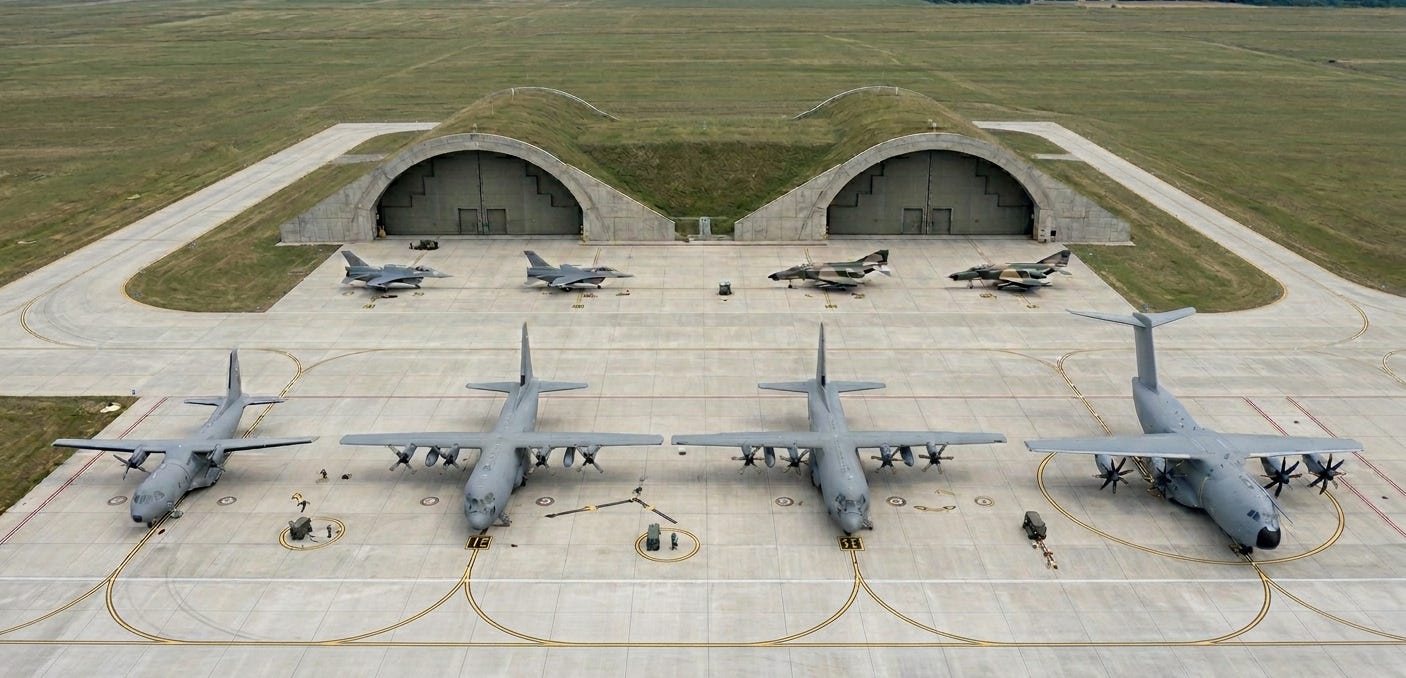
On November 11, 2025, a Turkish Air Force (TURAF) C-130E Hercules broke apart in flight over eastern Georgia, killing all twenty soldiers and aircrew aboard. The aircraft was fifty-seven years old. Built in 1968 and originally delivered to the Royal Saudi Air Force (RSAF), it had undergone TURAF’s indigenous Erciyes avionics modernization, a glass-cockpit upgrade that did nothing for the aluminum airframe beneath it. The cause of the crash remains formally undetermined. On April 3, 2026, a Gendarmerie Criminal Laboratory forensic report ruled out shrapnel, explosives, and improvised devices, but the technical investigation into mechanical failure is still in progress.
Twenty-six days before the crash, on October 16, 2025, Türkiye’s Ministry of National Defense signed a contract to acquire 12 retired C-130J-30 Super Hercules aircraft from the Royal Air Force’s (RAF) surplus stock at Cambridge. These airframes had been mothballed since June 2023, and 5 required new center wing boxes before they could re-enter service. For a NATO ally that has spent the past decade marketing indigenous drones, advanced jet trainer planes, and the KAAN fifth-generation fighter prototype as the face of a rising defense industry, the contrast is jarring. It is also revealing.
Türkiye’s overseas military footprint has expanded sharply since 2011. The strategic and tactical airlift fleet needed to sustain that presence has not. The gap between political ambition and lift capacity has widened to the point that Ankara is buying decades-old aircraft retired by another air force to plug a hole that should have been closed years earlier through ordinary force planning. As Hal Brands argues in What Good Is Grand Strategy?, the recurrent failure mode of statecraft is not a poverty of vision but a chronic mismatch between the ends a state declares and the means it actually fields. Martin van Creveld’s Supplying War makes the corollary point across three centuries of campaigns: the operational reach of any force is set, in the end, not by doctrine or political will but by what its logistics can move, when, and how far. Türkiye has spent the past decade building a defense industry without building the supply system that turns it into reach.
An Expanding Footprint
Türkiye’s overseas presence is now substantial. Bloomberg’s mapping shows Turkish forces across Northern Cyprus, Syria, northern Iraq, Qatar, Somalia, Libya, and Azerbaijan, including what it describes as an inkblot pattern of more than a hundred army outposts in northern Iraq alone. The northern Cyprus presence is the largest by personnel, but it relies on sealift and short-haul aviation across the Mediterranean. The harder logistical challenge lies in Türkiye’s expeditionary commitments.
The Tariq bin Ziyad base outside Doha, where Turkish troops first arrived in October 2015 and which expanded sharply after the 2017 Gulf blockade, hosts thousands of personnel. In Libya, parliament extended the deployment mandate in December 2025 for another two years. Turkish trainers and air-defense crews operate from al-Watiya, Mitiga, and Misrata. Several thousand personnel rotate through the network of forward outposts in northern Iraq. Camp TURKSOM in Mogadishu, opened in 2017 as Türkiye’s first African base, has trained more than 25000 Somali troops, including the Gorgor commando brigade.
Each of these commitments relies on a Turkish logistics chain. Libya, despite its proximity, requires long over-water sorties that quickly consume transport hours. The northern Iraq presence is road-accessible but depends on tactical airlift (helicopter) for sensitive resupply. Ankara frames all of this as strategic depth and soft power through uniformed forces. What the language obscures is the size of the fleet needed to sustain it, and beneath that, the political economy behind which capabilities Türkiye chooses to fund.
Ten Aircraft, Many Theaters
The TURAF operates exactly 10 Airbus A400M Atlas strategic transports, with the last delivered on March 29, 2022. Beneath them sit 18 aging Hercules: 6 C-130Bs and 12 C-130Es as of late 2025, following the November loss. The legacy fleet has accumulated over six decades. It began with an initial batch of C-130Es in the 1960s, followed by additional aircraft in the 1970s, 6 used ex-USAF C-130Bs in the early 1990s, and another 6 used C-130Es from Saudi Arabia around 2010. Every airframe in the legacy fleet has now flown for more than half a century. The Erciyes program, signed in 2006, gives the legacy fleet a glass cockpit and reduces aircrew requirements from five to four. It does not extend airframe life. It updates the systems housed inside aging aluminum.
This is the fleet expected to sustain one of the largest overseas footprints of any NATO member outside the United States. By comparison, the RAF operates 22 A400Ms and 8 C-17 Globemaster IIIs. France, whose Sahel experience offers the closest analogue to Türkiye’s African presence, declared full operational capability for its 24-aircraft A400M fleet in June 2025 (out of a 50-aircraft order) and supplemented it with 4 C-130Js ordered in January 2016. Germany, the largest A400M operator in Europe, is under contract for 53 planes. Türkiye’s expeditionary footprint matches or exceeds those three with a fraction of the lift.
Raw airframe counts understate the problem. Mission-capable rates, the share of a fleet actually able to fly on a given day, matter more than gross numbers, and Türkiye does not publish them. But analogues are sobering. U.S. Air Force data show mission-capable rates for the C-130H and most of the mobility fleet have declined steadily over recent years, with the C-130H sitting below 50 percent in fiscal 2023.
Even with a generous availability rate, 10 A400Ms cannot meaningfully cover concurrent commitments to Somalia, Qatar, and Libya, training detachments in Africa, and a NATO eastern-flank reinforcement contingency at the same time. The disparity is not about A400M raw capacity. It is about fleet generation.
The Sortie Equation
When the means leg shortens, but the ends and ways do not, the response is to fly the existing aircraft harder. A higher tempo accelerates fatigue accumulation in airframes already deep into the right-hand side of the bathtub curve. Wing-box cracks, undercarriage component wear, and turboprop hot-section degradation do not progress on calendar time. They progress on flight-hours and cycles. With every airframe in the legacy fleet past fifty years of service, even a modest tempo increase pushes the maintenance burden upward sharply.
The pattern is well documented. A longstanding study on aging aircraft shows that depot maintenance workload rises non-linearly as airframes accumulate hours and approach the end of their original design service life. The closest contemporary parallel to Türkiye is France. When Paris ordered 4 new C-130Js in January 2016, less than eighteen months into Operation Barkhane, the French defense procurement agency described its existing C-130H and C-160 Transall fleet as particularly overworked and fatigued by various overseas operations. France diagnosed the gap mid-deployment and acted. Türkiye allowed it to ripen into a procurement emergency.
The Techno-Nationalist Asymmetry
The deeper question is why. Türkiye’s defense-industrial trajectory over the past decade is not one of underinvestment. It is one of selective investment. Baykar, the most visible face of that effort, exported $1.8 billion in unmanned aerial vehicles in 2024 and $2.2 billion in 2025, and the Bayraktar TB2 is now in the inventories of thirty-four countries. TUSAŞ has unveiled prototypes of the KAAN fifth-generation fighter (first flown in February 2024, not expected in service before 2028), the HÜRJET advanced trainer, and the ANKA-3 flying-wing UCAV. The TCG Anadolu, built to accommodate the F-35B before Türkiye’s 2019 expulsion from the Joint Strike Fighter program, has been repurposed as a carrier for the Bayraktar TB3 drone. Each of these is a politically legible platform: visible, exportable, and reducible to a flag.
The capabilities that sustain forward presence are not. Tankers, transports, depot infrastructure, spare parts pipelines, and crew training pipelines do not photograph well. They are not exported in lots of six to a Gulf monarchy. They appear in budget lines, not at defense fairs. And they are precisely what Türkiye has not built. There is no public record of Türkiye placing an order for a single new-build strategic or tactical airlifter this decade. The Embraer C-390 Millennium, a contemporary jet-powered alternative to the Hercules, has been ordered or selected by Brazil, Portugal, Hungary, the Netherlands, Austria, the Czechia, Sweden, Slovakia, and South Korea. Türkiye is not among them. New-build C-130J orders from Lockheed Martin? None. The October 2025 buy of used RAF C-130J-30s is the only meaningful addition to the lift fleet since the final A400M arrived more than three years earlier.
This is not a procurement accident. It is a revealed preference. Having served in Türkiye’s security establishment between 2019 and 2024, I saw that senior decision-makers regard Türkiye’s presence across the former Ottoman space as a legitimate response to crises that implicate Turkish interests. What I never saw was an explanation for why the lift and sustainment tools needed to move that presence into the theaters they care about have gone unbought. This is, in Brands’s terms, a state whose ends and ways are clearly articulated but whose means are quietly underwritten by preference, not constraint.
Reactive Procurement
The October 2025 contract for the British C-130J-30s is the clearest sign of how late the recognition came. Türkiye took 12 of the 15 ex-RAF airframes, all retired in June 2023 as part of a cost-cutting measure announced in the 2021 Defence Command Paper. These are not new-build aircraft; they are 1990s-era airframes that Marshall Aerospace had been preserving at Cambridge while awaiting buyers. Marshall will replace the center wing boxes on each airframe and complete additional structural and avionics work before delivery.
The November breakup of a Turkish C-130 over Georgia closed that procurement story on a sober note. The aircraft, built in 1968, served the RSAF and entered Turkish service after the Erciyes modernization. Defense Minister Yaşar Güler said that, based on preliminary findings, the tail separated first, followed by the aircraft breaking into three sections. He cautioned that the determination was provisional pending black-box analysis. Independent observers noted that wreckage patterns were consistent with a failure originating in or near the center wing box. The April 2026 Gendarmerie report ruled out external causes; the structural investigation continues. Whatever the final verdict, the loss of an Erciyes-upgraded airframe makes one point unambiguously clear: avionics modernization is not an answer to structural fatigue.
The British buy is defensible on its own terms. The Hercules family is well known within Türkiye’s maintenance infrastructure, and using existing airframes shortens the path to lift capability compared with a clean-sheet program. But the deal also exposes two uncomfortable facts. First, the Erciyes program, which has seen nearly two decades of investment to extend the legacy C-130B/E fleet, is being quietly sidelined. These aircraft will likely retire earlier than planned, eroding the projected return on Erciyes. Second, the United Kingdom, a NATO ally with a smaller global presence, is selling Türkiye a platform Türkiye urgently needs. Had orders for new-build C-130Js or C-390s been placed earlier this decade, deliveries would now be nearing completion. They were not.
The Strategic Cost
What does this mean for Turkish defense policy? Three implications follow. First, surge capacity is limited. In any plausible scenario, whether rapid reinforcement of forces in Northern Cyprus, an airlift contribution to a NATO eastern-flank contingency in Romania or Bulgaria, the evacuation of citizens from a Middle East crisis, or the simultaneous resupply of multiple bases, the lift bill exceeds the available fleet. Türkiye then faces difficult prioritization decisions or must seek allied airlift, which carries its own political costs.
Second, the procurement asymmetry between visible platforms and unglamorous enablers is structural and will continue to shape planning unless deliberately corrected. Drones, fighters, and naval combatants attract political support and export revenue, whereas tankers, transports, depot infrastructure, and spare parts inventories do not. The next defense planning cycle should treat new-build strategic and tactical airlift as a discrete procurement priority, on a scale comparable to peer NATO operators, such as France’s 50 A400M order or the RAF’s combined 22 A400Ms and 8 C-17s, rather than as a residual category to be filled with whatever surplus another air force is willing to sell.
Third, allies and partners who assess the Turkish posture should recognize that the gap between Ankara’s stated ambitions and the state of its lift fleet means operational readiness depends on stretched, aging assets. The October 2025 decision buys time but does not solve the underlying capacity problem. The ex-RAF C-130Js will themselves age out within a decade, and overseas commitments must be explicitly tied to lift capacity in the next planning cycle or scaled back to match the fleet that actually exists.
Türkiye is arriving at this recognition late, and the cost is being paid in airframe fatigue, deferred depot work, crews flying more hours than planners ever assumed, and, on November 11, 2025, the loss of twenty lives over a Georgian field. The investigation into that crash remains open. The strategic question it raises does not. If Ankara wants to keep the forward presence it has built, the next defense budget has to fund the lift that gives that presence reach, not just the platforms that signal ambition.
Sertaç Canalp Korkmaz was a specialist at the Presidency of the Republic of Türkiye from 2019 to 2024. He holds a PhD and an MA in security studies from the Turkish National Police Academy, along with a BA in International Relations from Selçuk University. He served as an assistant researcher at the Center for Middle Eastern Studies (ORSAM) from 2016 to 2019. He was also a visiting lecturer at the Turkish Military Academy from 2021 to 2024. Dr. Korkmaz conducted field research in various cities in Türkiye and northern Syria. He was nominated to participate in the U.S. Department of State’s prestigious International Visitor Leadership Program for Autumn 2024.